
The Challenge
Crop inputs and agricultural commodities do not move through a vacuum. They move through systems that can become expensive, congested, and inflexible. For V6, the challenge was bigger than bringing fertilizer into market. It was how to create a more agile alternative to legacy routing while improving access for growers, opening room for new partners, and making better use of an underutilized trade asset in Eastern Ontario.
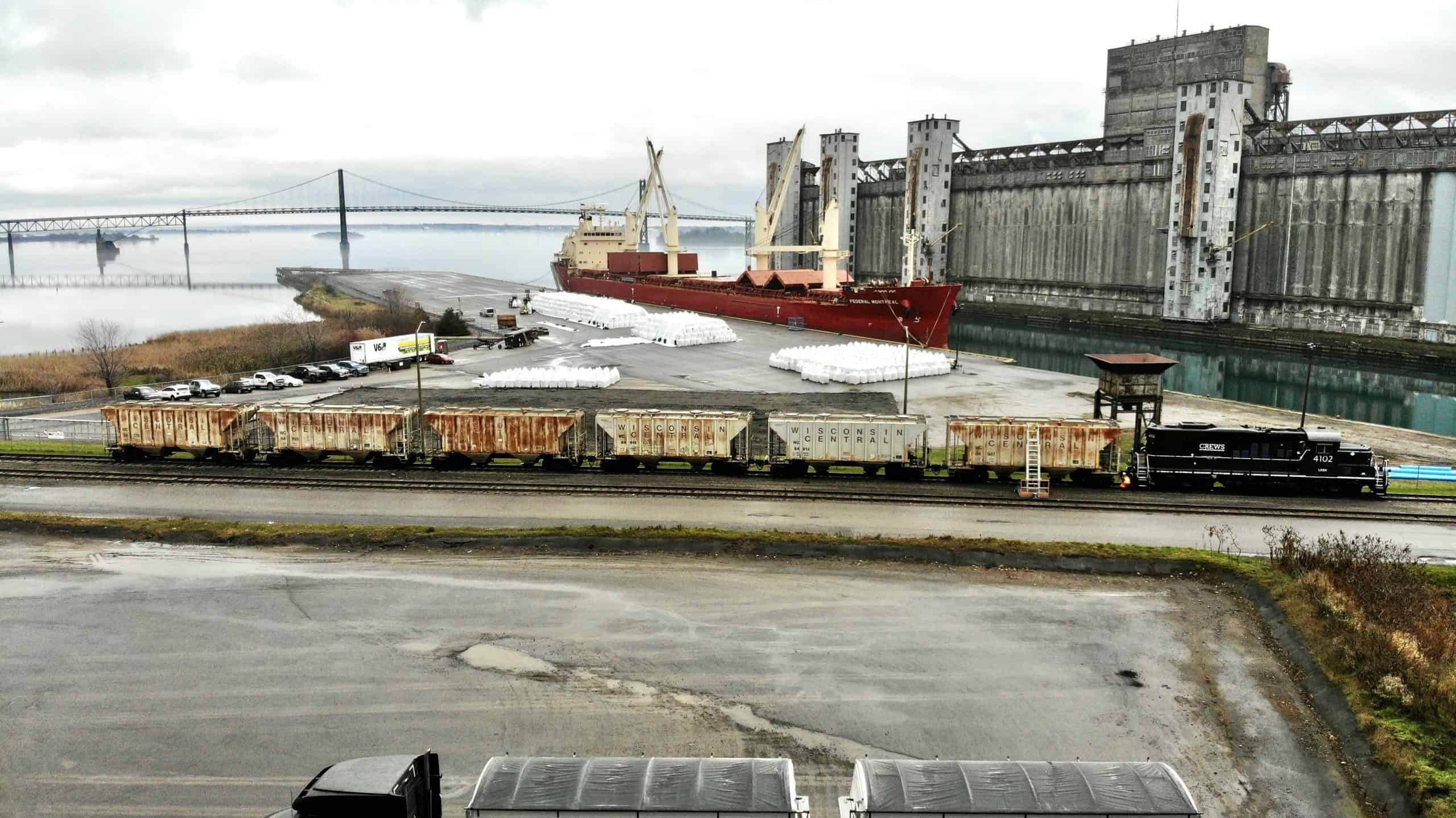
At the same time, the opportunity was hiding in plain sight. The Port of Johnstown already had the bones of a serious logistics platform: marine access on the St. Lawrence, rail connectivity, truck access, and room to evolve. The port describes itself as a trimodal facility and the only open port along the St. Lawrence Seaway that allows producers to sell grain to the trader of their choice. What it lacked was a commercial activator willing to connect the pieces and carry the risk.
The Port of Johnstown has operated since 1930 and is the only open port along the St. Lawrence Seaway that allows producers to sell grain to the trader of their choice
The Solution
V6’s model is straightforward in concept but powerful in practice: use Johnstown’s rail-marine-storage footprint to bring crop nutrition products in by vessel, handle and stage those products closer to market, and move them onward by rail and truck to the customers and regions that need them most.
The longer play is even stronger. V6’s planning has emphasized a circular trade model in which the same network that brings crop nutrition inward can also move grain and pulses outward. That creates a more compelling commercial story for carriers, brokers, logistics partners, and corridor stakeholders because it improves asset utilization rather than relying on one-way movements alone.
Public momentum is already visible. HWY H2O recently highlighted the collaborative effort between V6 AG and Fednav to move phosphate volumes on the Great Lakes, calling it added traffic and use of the trade corridor. The Port of Johnstown has also expressed confidence in long-term business with V6 around the handling and storage of incoming and outgoing crop nutrition products.
The port is a trimodal facility able to receive and ship by truck, rail, and marine vessel.
The Hero’s Turn
This is where the story shifts from product to platform. Rather than treat Johnstown as a stop on someone else’s route, V6 began treating it as the foundation for a new one. That meant rethinking its role — from crop nutrition supplier alone to corridor builder, partner convener, and terminal facilitator.
It also meant building relationships across the ecosystem: port leadership, marine carriers, rail stakeholders, growers, brokers, and export-oriented partners. Internally, the vision became clear: do not simply sell product through the system — help reshape the system so more product, more cargo, and more opportunity can move through it.
Port of Johnstown, Ontario
- Customer: V6 Agronomy
- Location: Port of Johnstown
- Date: April 2026
Why it Matters
What makes this model compelling is not only what it moves, but what it unlocks. For logistics partners, it creates new throughput, stronger use of existing infrastructure, and a chance to participate in a more flexible east-west trade flow. For shippers, it signals route optionality — a practical alternative to congestion and dependency on legacy gateways.
For HWY H2O, this is the kind of story that proves the corridor is not passive infrastructure. It is an active business platform when the right partners line up around it. That is the sales value of this case study: it shows how entrepreneurial operators can activate overlooked capacity and turn a trade route into a commercial advantage.
V6 is helping turn a one-way supply chain into a two-way corridor model by bringing crop nutrition inward and opening a pathway to move grain and pulses outward
Vessels and Terminal Assets
- Marine access at the Port of Johnstown on the St. Lawrence trade corridor continues to grow, including a trimodal terminal platform with truck, rail, and marine connectivity.
- Storage and cargo-handling capability supporting inbound and outbound flows, while Partner momentum for Great Lakes phosphate movements increases with this new capacity.
- The move provides a platform model that can support fertilizer, grain, pulse, and future cargo opportunities.